


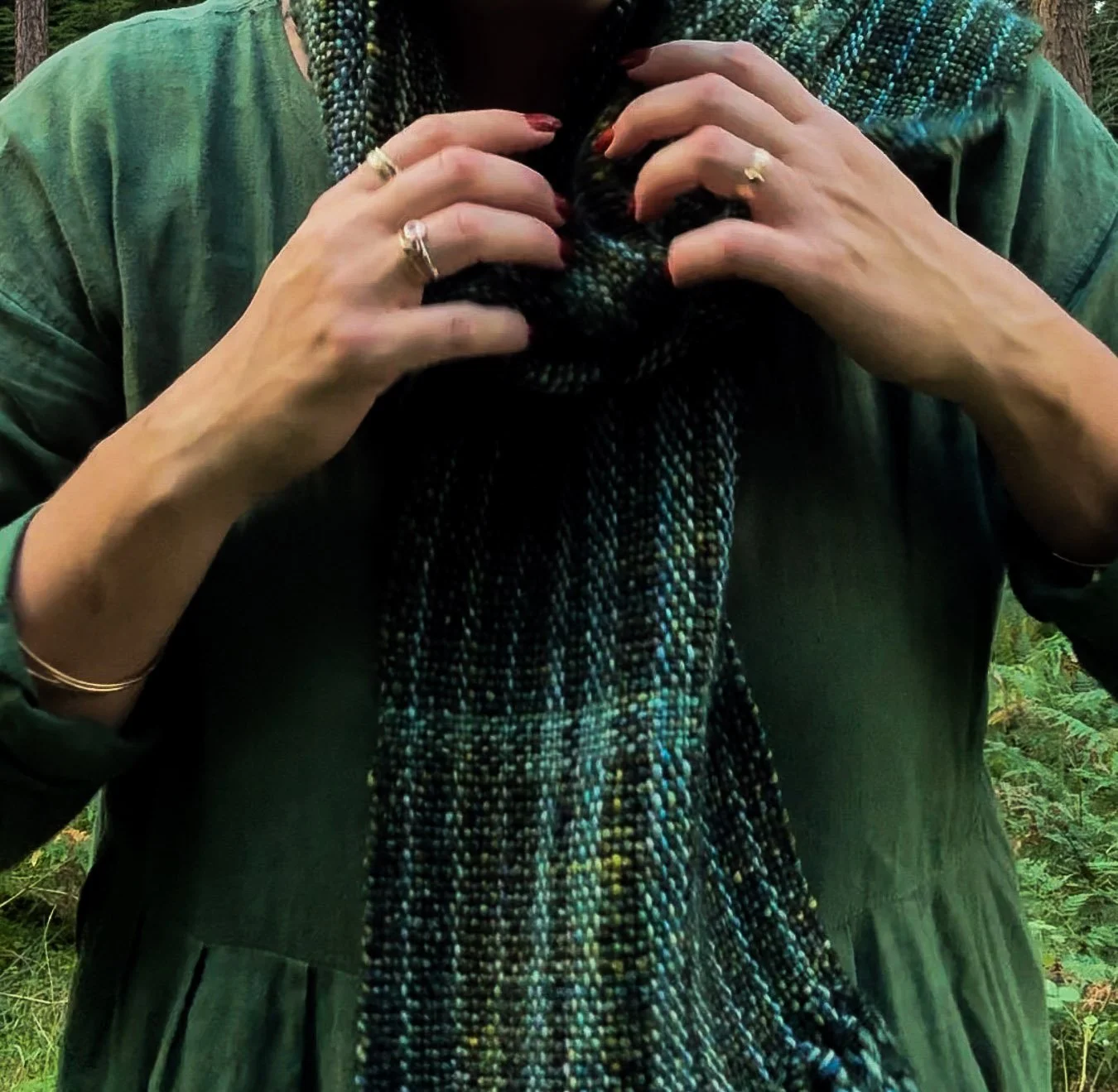

Hello, my name’s Hannah. I live in the far North East of England, on the edge of the moors in rural County Durham.
Every scarf and wrap I weave is one-of-a-kind, painstakingly handmade with love, care and intention.
I’ve never been much of a knitter or a crocheter; I enjoy allowing my mind to wander whilst my hands are busy, rather than following a pattern. Give me a cosy woodburner, a massive mug of herbal tea in my favourite witchy mug, rain on the windows and a good podcast or three and I’ll be lost to the world for hours.
I taught myself how to weave not so long ago when I took a year-long break from running my jewellery business. Suffering from burnout and creative fatigue, I knew I definitely still wanted to work with my hands, but with much gentler materials and equipment.
I wondered initially whether I’d find the repetitive physical nature of weaving boring, but in fact it’s quite the opposite. As it turns out, I have weaving in my blood: my ancestors were Huguenot silk weavers in 18th century Spitalfields, in the heart of London’s notorious East End.
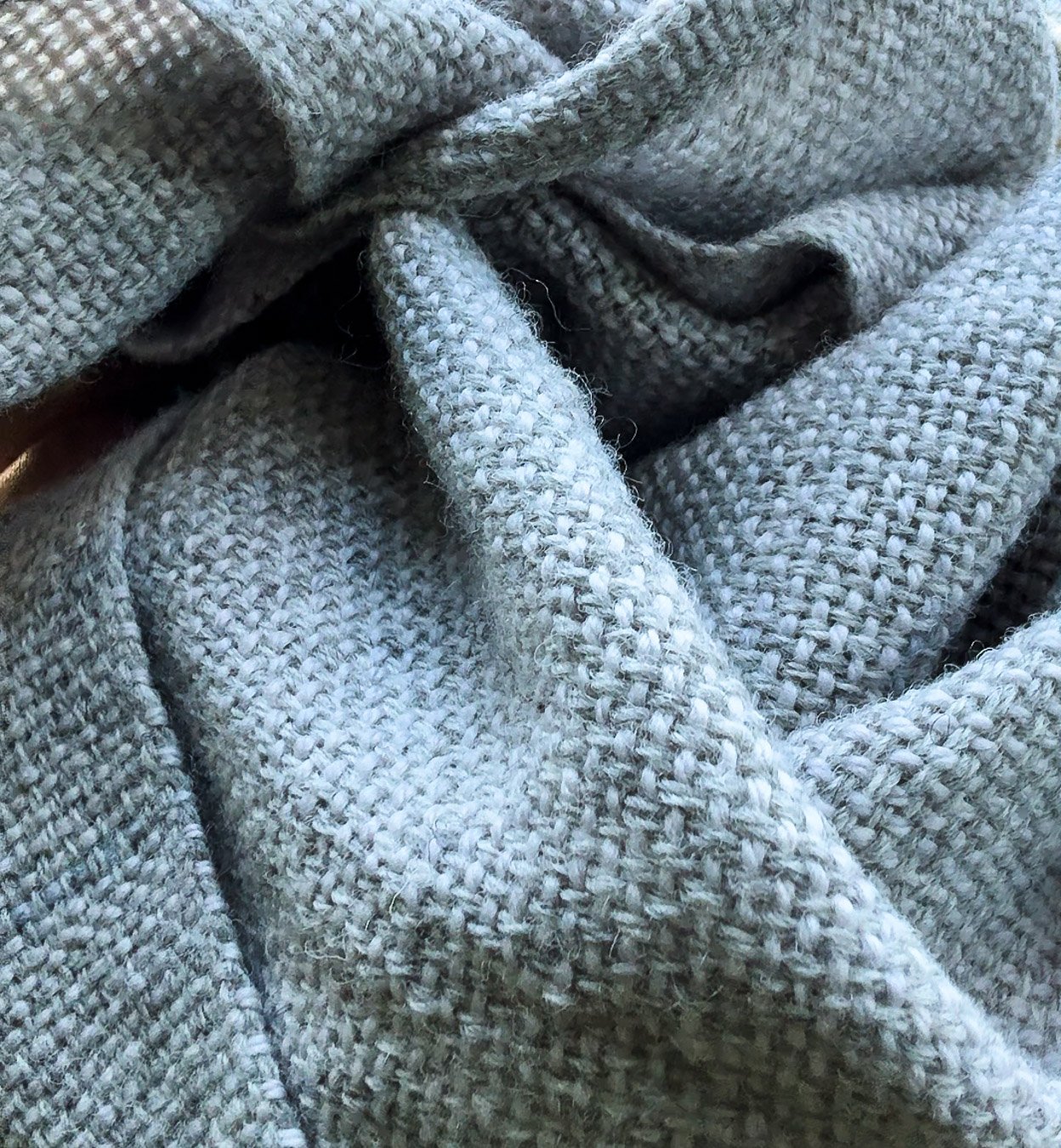
All my scarves, shawls and homeware pieces are made with luxury natural fibres including Merino, linen, baby camel, alpaca, yak, silk and cashmere. I particularly focus on using hand-dyed yarns and hand-spun fibres from small British-based farm producers and artisans.
Thank you for visiting my website. Please keep an eye on the SHOP page or follow me on Instagram @theweardaleweaver for updates.
awards
2026 Highly Commended award at Great Northern Contemporary Craft Fair Newcastle
2026 GNCCF Arts Council Bursary
FAQS
What’s the difference between yarn and wool?
Wool is yarn, but yarn isn’t always wool! Yarn is a catchall term for any fibre which has been spun so that it can be knitted, crocheted or woven. The term “yarn” also encapsulates vegetable fibres such as linen, and of course silk. Wool generally refers to spun fibre from the soft coat of a mammal, such as sheep, goats, alpacas, yaks or camels.
Do you use manmade fibres?
No, never. I just don’t enjoy working with them. There is something very special about weaving with natural fibres; their softness, tactility and durability is unmatched.
Is the yarn you use ethical?
The traceability of all the fibres I use in my weavings is of huge importance to me. Please take care to read the individual “Yarn Story” in each listing … or, if you’re viewing one of my pieces at an event, you’ll find this information on the introduction card pinned onto each piece. I give as much information as I can on the fibres I’ve used in that particular piece. All the yarn I use, without exception, comes from small businesses, mostly women run/owned, and local British small-scale ‘farm-to-yarn’ producers.
How long does it take you to weave a scarf?
How long is a piece of wool?! It depends on the complexity of the weaving, the size of the finished piece and the fineness of the yarn. Warping up my loom usually takes me around 2 to 4 hours. The actual weaving itself can take anything from 5 hours to more than 45 hours. The final cutting off, tassel-twisting and the rest of the finishing usually takes another couple of hours.
What’s the difference between warp and weft?
The warp threads are the longer strands of up-and-down yarn which make up the length of the scarf and the tassels at each end. The weft threads are the shorter side-to-side lengths of yarn which are threaded through the warp, thus creating the woven fabric. Think of it as “weft: right to left!”.


